In recent months, there has often been talk of a presumed "blanket ban" on single-dose packaging. The reality, as is often the case, is somewhat more nuanced. If you are a company operating in the food, personal care, pet food, and pharma sectors, it is important to be well-acquainted with the new European rules, and the related implementation timelines, to make correct and defensible packaging choices in the coming years.
In this guide, we will explain what changes and what does not in the different markets, based primarily on the situations of use of the single-dose items.
PPWR and single-dose: what happens from 1 January 2030
In the European Union, the new reference legislation is the PPWR - Regulation (EU) 2025/40 on packaging and packaging waste. The regulation entered into force on 11 February 2025, with general application from 12 August 2026 (18 months later). Various measures have deferred entry into force, for example, 2028, 2030, or 2040.
The article introducing targeted bans on specific packaging formats/uses is Article 25, which refers to Annex V (EUR-Lex, Reg. 2025/40) effective from 1 January 2030 (EUR-Lex, OJ L 2025/40 PDF).
The legislation does not eliminate single-dose items en bloc: it combines cross-cutting requirements (e.g., minimisation, design for recycling) with targeted bans on certain formats/uses.
In particular, from 1 January 2030, the following will be prohibited:
-
Single-use plastic packaging for sauces and condiments in the HORECA sector.
-
Single-use packaging for amenities (cosmetic and hygiene products) in the hospitality sector.
Let us look in detail at what changes for those producing packaging in the food and personal care sectors.
Food: no to single-use plastic packaging in HORECA for on-site consumption
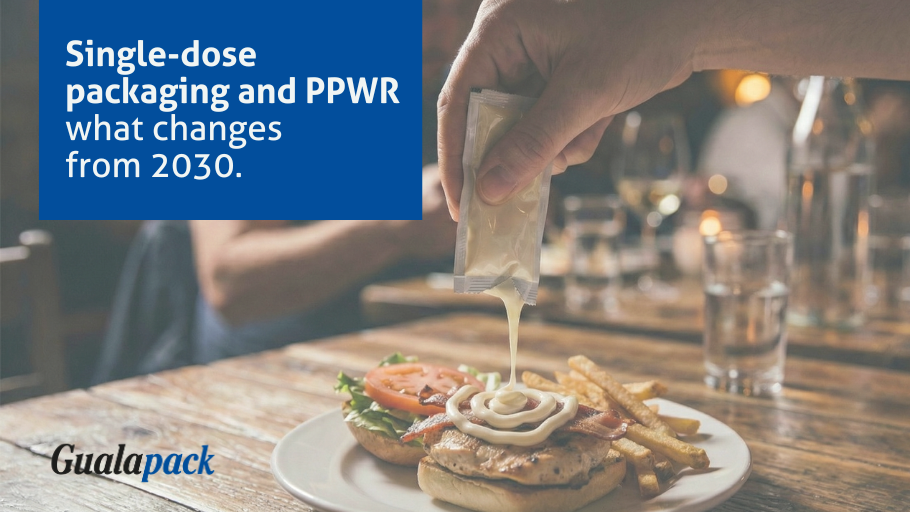
From 1 January 2030, the PPWR prohibits the use of plastic packaging for individual portions in the HORECA sector (bars, restaurants, and similar), for on-site consumption (dine-in) of products such as:
-
Sauces and condiments: ketchup, mayonnaise, mustard, or other dressings
-
Seasoning: salt, pepper, spices, and similar
-
Preserves: jams, honey, butter
-
Sugar and coffee creamer
We are therefore referring to all those classic single-dose plastic packs served at the table in bars, restaurants, or for breakfast in hotels and consumed on-site together with one's order.
The ban specifically refers to plastic, so paper packaging is excluded. However, it must be remembered that packaging is considered plastic if its plastic content is equal to or greater than 5%.
Exceptions to know:
- Take-away / ready-prepared food / delivery service: Situations where the food is ready for consumption, whether delivery or take-away, are excluded from the ban.
- Establishments with medical requirements: when necessary for safety/hygiene (e.g., hospitals, clinics...).

Image from PPWR survival guide
Retail / GDO: what changes?
The ban on single-dose items does not extend to products sold to the consumer, such as multipacks of sauces. The PPWR indications regarding packaging minimisation and "design for recycling" remain valid.
Personal care: no to single-dose in the hospitality sector
Also known as "amenities", these are the containers of shampoo, shower gel, liquid soap, or other personal hygiene products generally found in hotel rooms.
From 1 January 2030, the PPWR prohibits the use of all types of single-dose packaging for cosmetics, hygiene, and toiletry products intended for an individual booking in the accommodation sector (EUR-Lex).
In this case too, what makes the difference is not so much the single-dose format, but the context of use; therefore, in this instance, the ban concerns the hotel/hospitality sector. Here, the ban refers generally to single-use packaging, without specifying the material (European Parliament).

Image from PPWR survival guide
Retail / GDO: what changes?
Single-dose packaging is increasingly common on supermarket shelves, such as travel sizes, face masks, or samples, but the law does not explicitly cite this type of product.
Summary Table
|
HORECA |
Take-away / Delivery |
GDO / Retail |
GDO / Retail |
|
|
Plastic packaging for individual portions (Food) |
BAN |
OK |
OK |
OK |
|
Single-dose packaging for personal care products |
BAN (Hospitality Sector) |
N/A |
OK |
OK (Samples/Retail) |
The Gualapack offer in compliance with the new regulations
Article 25 of the PPWR does not introduce a blanket ban against all single-use packaging: it targets specific modes of use, particularly HORECA (on-site consumption) and hospitality (individual bookings) starting from 1 January 2030. In general, the PPWR strengthens the principle of design for recycling and packaging minimisation for the entire EU market (EUR-Lex, OJ L 2025/40 PDF).
As a leader in the flexible packaging sector, we are always attentive to developments in new European sector regulations to offer our partners a range of practical, efficient solutions compatible with the legislative horizon.
Regarding single-dose items specifically, where the ban only affects plastic packaging — as in the case of HORECA — a valid alternative is constituted by our Papersnap. Papersnap is the paper-based version of Easysnap single-dose sachets, characterised by easy opening and suitable for liquid and semi-liquid products. Being composed of 85% paper and containing less than 5% plastic, it is recyclable in the paper stream.
Where the use of single-dose plastic packaging is permitted—for example, for sauces in take-away or for samples of personal care products intended for GDO/Retail—our monomaterial laminates satisfy the fundamental requirement of Design for Recycling (D4R).
In general, it is possible to replace single-dose items with rigid dispensers that dispense the product, for example for sauces and condiments in HORECA, or for cosmetic products in hospitality. In this case, a valid solution offered by Gualapack are refill pouches: lighter, with lower plastic content, and more ecological, perfect for all liquid and semi-liquid products, both food and non-food.
If you have doubts about the application of the PPWR to your channel (HORECA/GDO/Hospitality) or want to evaluate alternatives compatible with your barrier and shelf-life needs, contact one of our experts to identify the most suitable solution for your needs together.


FAQ
Does the PPWR ban all single-dose packaging in Europe?
No. The PPWR introduces general requirements for all packaging and targeted bans from 1 January 2030 for specific formats/uses via Art. 25 + Annex V. In particular, the following will be banned: single-dose plastic packaging for sauces and condiments in the HORECA sector, and single-dose packaging for cosmetic and hygiene products in the hospitality sector.
Will single-dose sauces be banned?
It depends on the context. The most critical case concerns plastic packaging for individual portions served in the HORECA sector for on-site consumption. Significant exceptions exist (take-away ready-prepared food and contexts with medical/health requirements).
Will single-dose sauces sold in the GDO (Retail) be banned?
No. The cited ban concerns use in HORECA (on-site consumption) for certain single-use plastic categories; in the GDO, general requirements remain central (minimisation, recyclability according to criteria and deadlines).
Does the PPWR ban single-dose packaging for pet food?
There is no ban on single-dose packaging for pet food; primarily, the general PPWR requirements apply (minimisation, design/end-of-life).
Will single-dose items (sauces/condiments) be banned in hospitals?
No, the PPWR provides an exception when single-use packaging is required for safety and hygiene in establishments with medical requirements (hospitals, clinics, nursing homes).
Will cosmetic samples in Retail/GDO be banned?
No, the clearest ban concerns amenities in the accommodation sector from 2030; for Retail/GDO, the focus is on general requirements of design/minimisation and recyclability.
Does the ban on single-dose items also concern paper?
It depends on the context, the type of ban, and the characteristics of the individual packaging.
-
In the case of individual portions in HORECA (on-site consumption), Annex V refers to "single-use plastic packaging": therefore, it is not a blanket ban on all materials.
-
In the case of hospitality/amenities (mini-sizes in hotels), however, the ban in Annex V is formulated more broadly as "single-use packaging": therefore, it may also concern non-plastic packaging, depending on how it is used.